


Let me preface this post with this,… I love Ai. It’s not a fad. It’s real and it’s changing the world.
The point of this particular post is to educate folks with actual data, specifically when it comes to Ai search, and in the process, squelch some of the misnomers surrounding the search ecosystem right now.
Every day I see business owners who have barely a free moment in their day, chasing the latest Ai click bait headline directly into a rabbit hole that costs them real time and money.
The internet is currently a breading ground for Ai fear mongering, usually led by pitch-men selling Ai products & services who don’t understand the data themselves, yet are positioning their products as a “non-negotiable”, or you’ll risk “never being found online ever again.”
These things trouble me, so this post may be a little longer, but I guarantee you well worth the read, especially if you love real data.
Let’s start with the big one…
ChatGPT vs. Google (Search Market Share)
There are a lot of people on YouTube & LinkedIn who want you to believe that Ai platforms like ChatGPT are the only place people are searching right now.
It’s a fact that ChatGPT has gained market share rapidly, but let’s look at the facts, along with some documented data below.
First, we must understand that Google still OWNS search. This is not a hypothesis or my opinion. This is fact.
And whatever ChatGPT does now or does in the future, in terms of features/functions, Google can do equally as good, or better. That’s not a slight to ChatGPT its just reality. Google is a top-5 global power and has the compute power to compete with anyone in the Ai or search space.
Google has a 20+ year head start on ChatGPT in terms of data, and hundreds of millions of people are already hard-wired to use Google when looking for an answer or service provider.
And the proof is in the pudding…
Current Market Share Data
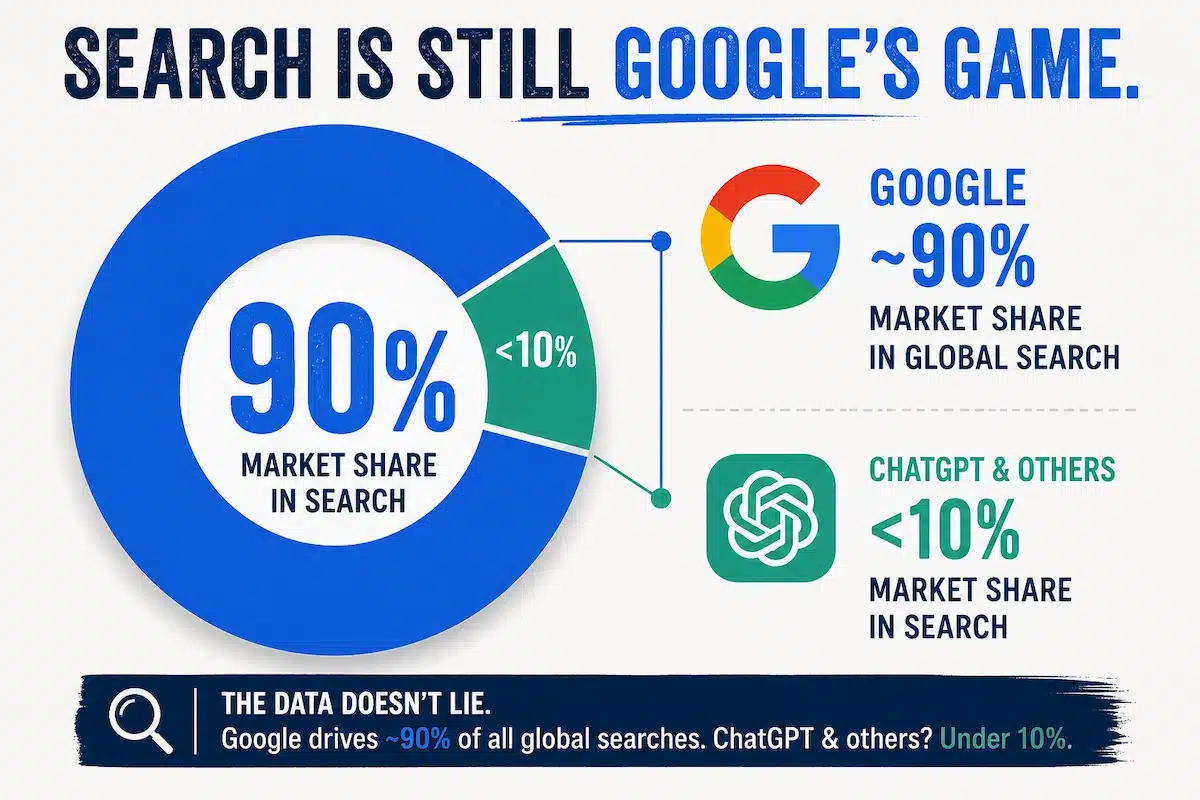
At of the time of this post, Google has roughly a 90% market share in global search, with ChatGPT and alternative search platforms (Bing, Perplexity, DuckDuckGo) making up the remaining 10%.
If you just look at May 2026, Google has 99.55% market share, with ChatGPT at .42%.
Google search volume is roughly 13.7 billion searches per day.
In 2025, ChatGPT processed about 2.5 billion per day.
Both are big numbers, but that’s a massive gap with Google driving nearly 40% of all global search traffic. ChatGPT is hovering at .21%.
Interestingly, ChatGPT’s market share as an Ai assistant fell below 50% for the first time ever recently with the emergence of Gemini and Claude.
User Demographics (important)
If you’re an insurance agent, your ideal customer is likely someone between 35-65+, with assets to protect. A house, multiple cars, a business, a family that needs to be protected by a life insurance policy.
However, when you look at the user statistic by age, that’s not the type of consumer who is using ChatGPT.
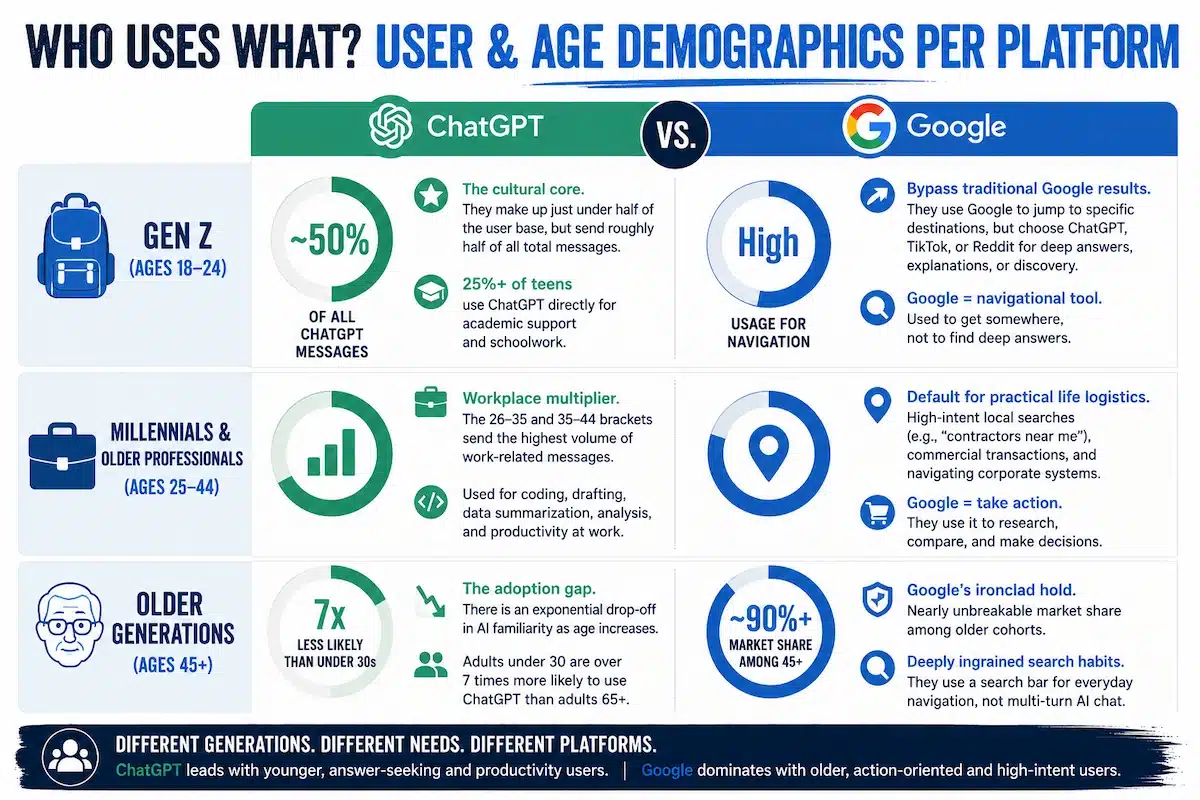
The user demographics of ChatGPT are more in line with TikTok than they are with Google, Meta, & LinkedIn. This is something that most marketers conveniently skip past, or are completely unaware of as, they are pushing some new Ai website scanner on you.
Key takeaway especially if you’re an insurance agent: your ideal client is really not on ChatGPT.
Is that to say you will never get a policy holder from ChatGPT? Of course not. Its possible, but you don’t need to obsess with “ranking in ChatGPT” (which isn’t really a thing btw) because almost 100% of ChatGPT users aren’t using the platform to buy anyway.
More on that here…
User Intent (SUPER important)
Even more important than sheer volume, is the actual user intent per-platform. How people use these two platforms is vastly different you must understand this before you go chasing one or the other.
If you’re a business owner looking for leads, this is what you should pay the most attention to from this post.
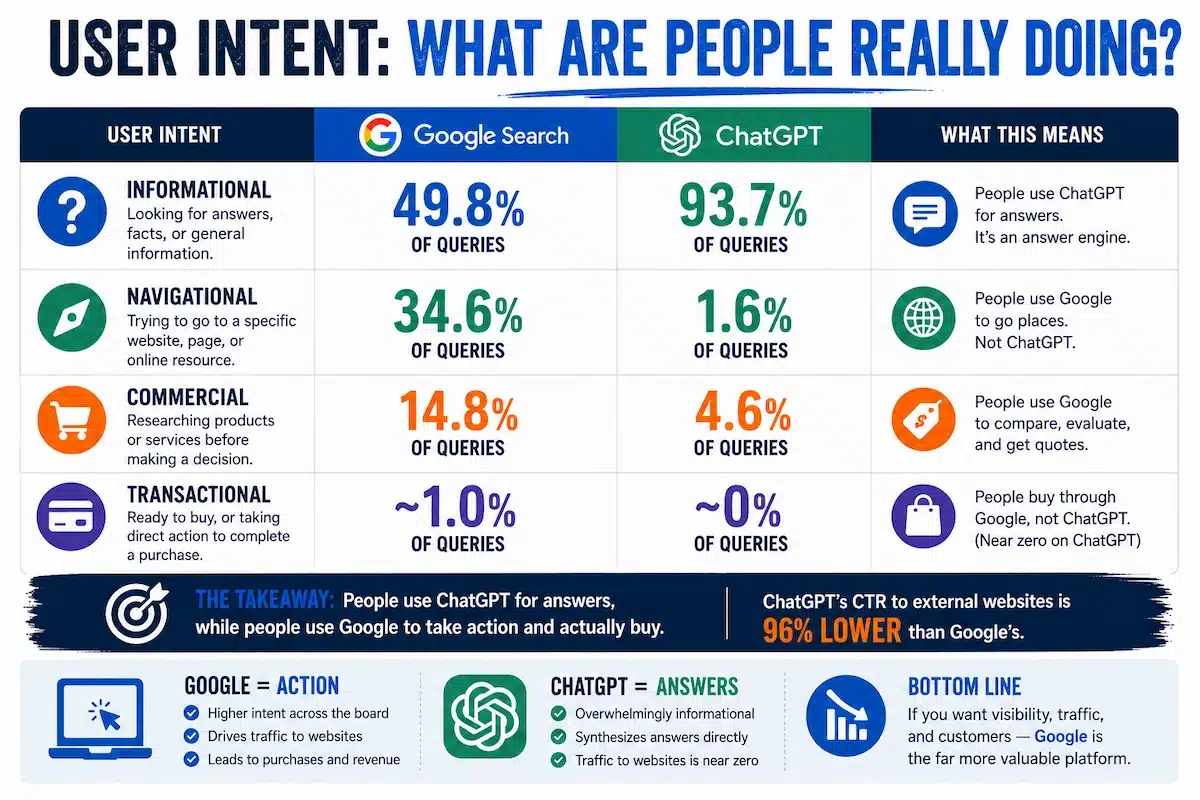
49.8% of Google queries have “informational” intent. A.k.a. people have a question they need an answer to.
93.7% of ChatGPT queries are also “informational”, meaning, people are almost exclusively using ChatGPT for information, as an answer engine. This is not breaking news of course.
34.6% of Google searches are “navigational” to 1.6% in ChatGPT. A.k.a. when someone wants to go directly to a website or resource, they are NOT using ChatGPT.
14.8% of Google searches have “commercial” intent. Someone who is looking to buy, get a quote, estimate, etc. 4.6% in ChatGPT.
~1.0% of Google searches are “transactional” (directly clicking an ad or product listing to buy instantly), and near 0% in ChatGPT.
The takeaway from this data is this: people use ChatGPT for answers, while people use Google to take action and actually buy.
Also, because ChatGPT synthesizes answers directly, its overall CTR to external websites is 96% lower than Google’s.
A.k.a. you can expect close to zero clickthrough to your website from ChatGPT, and that’s saying a lot because Google clickthrough is also dropping significantly because of it’s own Ai overviews.
I covered this previously, and we are all living in a zero-click environment with Ai making it harder and harder to get organic website traffic.
Key takeaway: If you’re a business owner who wants to make money, Google is a significantly more valuable platform compared to ChatGPT.
(Side note, depending on your industry & client demographics, META is better than both of them! Facts.)
A few other major advantages that Google has over ChatGPT as a search product is, Google has its own search browser (Chrome) and the Google Maps product.
Those are two “big deals” and there has been an explosion of people who are now using the Google Maps app as their primary way of finding local businesses.
If you were looking for the nearest coffee shop, mechanic, or independent insurance agency, it just makes sense to use Google Maps, as it’s a more immersive experience that shows user reviews, directions, and other key info about the business.
Bottom line — when it comes to data, search volume, and user-intent, ChatGPT isn’t in the same league as Google. It’s not even close.
Schema, LLMs.txt, Markdown, and “AEO”
There are a growing number of SEOs, marketers, and other “know enough to be dangerous” practitioners who truly believe in their own mind that if your website doesn’t have advanced schema markup and an LLMs.txt file, that you simply don’t exist on the internet.
They’re also separating AEO (answer engine optimization) from SEO, and trying to sell it as a stand-alone high-ticket service, when in reality, they are largely the same thing and don’t require different practices.
Here are the facts, and this is right from Googles’ own mouth…
LLMs.txt files and special markup are not used, and not necessary for LLMs to understand your content. HTML is still what crawlers want.
Also 97% of llms.txt files never get read anyway.
AEO vs. SEO: Which Is Better? Spoiler alert…
I’ve seen folks ask this exact question, not understanding that AEO and SEO are really about the same thing — providing helpful content and driving off-site signals (backlinks, mentions, etc.) that make that content more authoritative in the eyes of the platform.
It’s a fact….schema isn’t required for generative Ai search.
Fwiw, schema has been around for a long time prior to this whole Ai boom.
We implement it on our client sites because it’s a loose “best practice” and pretty easy to do, but in 15 years of building websites I’ve never had someone say, “yeah they found me because of my schema.”
I’m sure a lot of so called SEOs would disagree, but I’ll trust Google’s own words in this case.
If you or your client can legitimately attribute real revenue back to schema, (or an LLMs.txt file), please feel free to call me out.
These things may change in the future, but if LLMs aren’t using them already, that’s somewhat telling.
Ai Generated Content
There are a growing number of tools and platforms that can now connect to your website and auto-generate Ai blogs. Many of them claim to “rank your website #1” for said article.
The good thing about these tools is, to a window shopper, it looks like you’re updating content on your website regularly, which is not for nothing.
But, out of Googles’ own mouth, commoditized content is virtually useless and not rewarded under Google’s ranking system, yet that’s the exact type of content that these Ai auto-bloggers are creating.
These tools give website owners a false sense of progress, and some of them can be $200-$300/mo.
The idea of ranking a brand new piece of content #1 (whether created with Ai or not) is simply a myth you shouldn’t so easily fall for. There is so much click bait online for this, its insane.
“Just create good content” has always been bad advice.
The modern web is over-saturated with web pages and blogs. Every day millions of new pages are created in hopes of ranking in search. Less than 1% do.
In fact, roughly 97% of content on the web gets zero traffic from Google.
Most blogs and product pages fall on deaf ears.
Most Content Is Never Indexed Anyway
This is because Googlebot’s crawl budget (Google’s web crawler) simply can’t keep up with the demand and volume at which new content is created, thus millions of pages are simply never indexed.
Even if you have a completely unique, well written piece of content, its very hard to outrank more mature sites that have higher domain authority.
Written content was already a commodity before Ai came on the scene, and now it’s even worse.
If you want to differentiate your website and your agency, create more video.
YouTube is the #1 most cited web property in Google Ai overviews currently. If you want traffic, create authentic video content on YouTube and link back to your website in the video description.
Blogs and product pages are not completely useless, but few people read them on-site, and very seldom will they rank for anything on page-1 of Google.
6 Critical Takeaways
To people who don’t know me, I may come off as a curmudgeon with these kinds of posts, but the people who do know me know that I rant about this stuff to protect my friends, customers, and other business owners who can ill afford to waste time on the latest shiny object, or tactics that yield virtually zero ROI.
No, I don’t think Ai search is a fluke, I realize a lot of people use it, its not going away, and hopefully a year from now this post makes absolutely no sense because it gets better and starts sending more users back to websites like it did 5-10 years ago.
Okay rant over…here’s my round-up:
- If you’re a business owner, specifically an insurance agency, the data is telling you, you don’t need to obsess over ChatGPT. Yes, people use it to research and you shouldn’t just not care about it, but step back and ask yourself, is my ideal client really there?
The truth is, a lot of people use ChatGPT for fun, and light research. They use Google to validate and buy. Ultimately Google has more search volume, more purchase intent, and a more mature demographic of prospects. - If you’re worried about being recommended or cited in Ai search, being cited in Googles’ own Ai overviews is much more important than being cited in ChatGPT.
Just understand the piece of content you want cited needs to be ranking top-3 for the topic to be in an Ai overview, OR have an exact-match title tag to the actual search query.
The reality is, most small business owners will never be cited in an Ai overview because they are simply not creating content or videos that match search intent, OR, they’re in a SUPER competitive industry like insurance, lending, auto, where larger brands/sites own search. - The biggest reason you’d show in Google search or ChatGPT if someone is looking for a local service provider is your Google Business Profile and/or Bing Places Profile. Not your website. Not schema. Not an LLMs.txt file. Not some Ai website scanner or Ai content tool.
- Your website is one factor in a larger equation in search now. Ten years ago, it was all that mattered. Now, being found online and cited in Ai is the sum of all of your online properties, and yes, your insurance agency website is still an extremely important part of that sum.
- Don’t believe everything you read and don’t believe everything people tell you, especially if it’s a peer who doesn’t do these things for a living.
I know a lot of business owners who are in Facebook groups together and a lot of the time, facts get skewed on the way down the grapevine to the point where they are all basically spreading hearsay that is the opposite of the truth.
“But Chris, so-and-so said I need this for my website to rank”. Guys…stop falling for this.
There are a lot of well respected marketers who truly know what they’re doing and have the clients’ best interest in mind. But for every one of them, there are 50 other charlatans who don’t know what they don’t know, but they sure do talk a good game.
If a marketer tells you that if you’re not being recommended in ChatGPT, then your business is completely invisible and your website is garbage, they either drinking the Ai Kool-Aid, have zero data behind their pitch, or it’s complete fear mongering in an attempt to sell you software or services that your Google/Bing Business Profile is already doing for you, for free. - And I’ll leave you with this… as a business owner, don’t wait for people to find you in Google or ChatGPT. Go get the business!

